On April 4, 2012 a new chapter began in the history of the Marlins as they played their first game against St. Louis Cardinals. The team moved from the largest stadium in baseball to the smallest as Marlins Park has a seating capacity of 37,000. Three levels of seats extend from the left field foul pole around homeplate to the right field foul pole. Two levels of seats are located above the right field fence with limited seating located behind the left field fence. Unlike the majority of MLB ballparks built, Marlins Park has a futuristic design that looks forward and breaks away from the traditional retro ballpark design. A brick facade is not found here. Instead, the facade consists of white stucco, silver metal and glass. The three panel retractable roof prevents any rain delays and opens or closes in 13 minutes. When open it sits behind the first base grandstand on the west side of the ballpark. Here, on the outside of the ballpark, is a large gathering plaza that allows fans to mingle before games.
Marlins Park has a number of unique features around the ballpark. Not only does the ballpark feature a retractable roof, but retractable outfield glass panels. Located behind left field, these panels, six combined at 240 feet long and 60 feet high, open or close in eight minutes and provide a panoramic view of the downtown Miami skyline. Behind the outfield fence in left-centerfield is one of the most unique homerun features in baseball. The colorful, $2.5 million, 75 feet tall structure features moving waves along the bottom 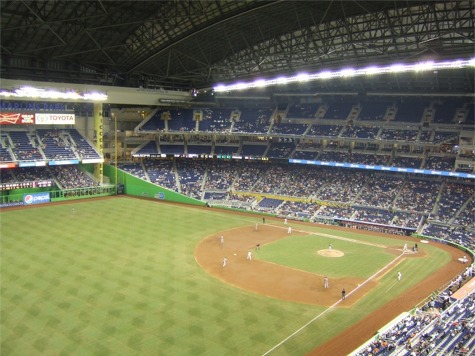
and spins marlins, seagulls and flamingos anytime a Marlins player hits a homerun. Marlins Park will be the second ballpark in baseball to feature a pool
